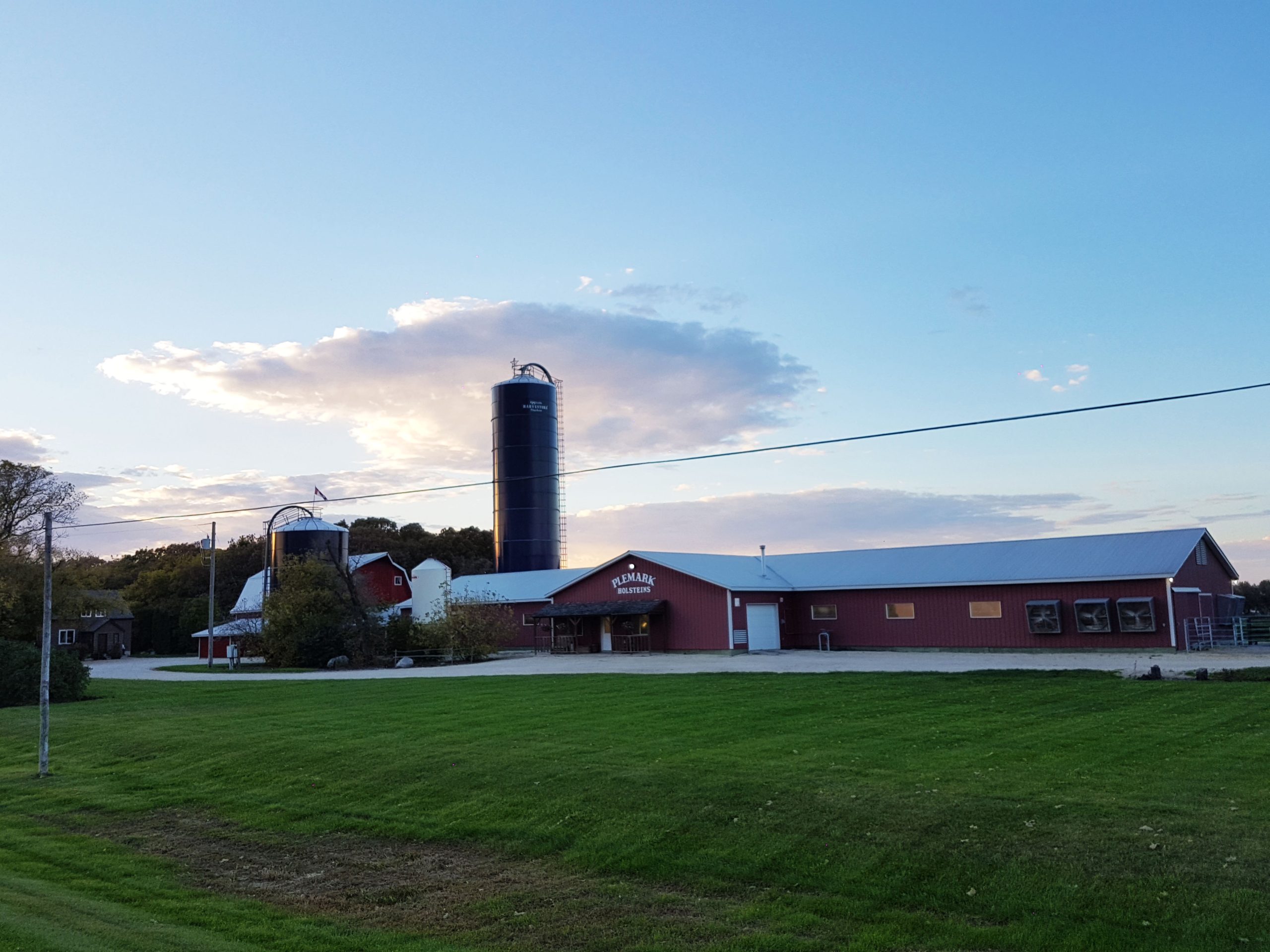
Canadian dairy farmers operate in every province. More than 9,000 dairy farms produce milk for Canadian consumers and processors within a system built around supply management, national quality standards and regulated marketing.
This page provides an overview of Canada’s dairy farms, the role of Dairy Farmers of Canada, the basic structure of milk production and the sector’s main economic and trade issues.
How many dairy farms are there in Canada?
As of August 1, 2025, Canada had 9,048 dairy farms shipping milk. Dairy production exists in all ten provinces, but it is heavily concentrated in Quebec and Ontario. Together, those two provinces account for more than four out of every five Canadian dairy farms.
The table below combines the number of milk-shipping farms with the number of dairy cows reported for 2025. The average herd size is calculated from those two figures, so it is best read as a broad provincial comparison rather than a measure of cows actually being milked on every farm at a given moment.
| Province | Dairy farms | Dairy cows | Avg. cows per farm |
|---|---|---|---|
| Quebec | 4,134 | 354,200 | 86 |
| Ontario | 3,155 | 325,000 | 103 |
| Alberta | 459 | 86,300 | 188 |
| British Columbia | 421 | 81,100 | 193 |
| Manitoba | 221 | 41,800 | 189 |
| Nova Scotia | 191 | 21,200 | 111 |
| New Brunswick | 162 | 16,000 | 99 |
| Saskatchewan | 145 | 28,600 | 197 |
| Prince Edward Island | 138 | 12,200 | 88 |
| Newfoundland and Labrador | 22 | 5,200 | 236 |
| Canada | 9,048 | 971,600 | 107 |
Quebec alone had 4,134 milk-shipping dairy farms in 2025, or about 46% of the Canadian total, and the largest provincial dairy-cow population at 354,200. Western farms tend to be larger on average, while Quebec and Ontario have many more individual dairy operations.
The long-term trend is toward fewer, larger farms. Canada had 10,679 dairy farms in 2018 compared with 9,048 in 2025, a decline of roughly 15% in seven years.
Canadian dairy farms nevertheless remain overwhelmingly family-based. Dairy Farmers of Canada reports that roughly 98% of Canadian dairy farms are family owned and operated, and close to nine out of ten farms have fewer than 200 milking cows.
What is Dairy Farmers of Canada?
Dairy Farmers of Canada, or DFC, is the national organization representing Canadian dairy producers.
It is not a government department. It is producer-funded and producer-led, represents farmers with the federal government, participates in agricultural and trade-policy debates, and carries out promotion, research and public-information activities.
Farmers are also represented by provincial organizations. In Quebec, for example, Les Producteurs de lait du Québec play a central role in collective milk marketing and provincial representation.
How does dairy production work in Canada?
Canadian dairy production operates under supply management. The basic principle is to adjust milk production to the needs of the Canadian market.
The system relies on production quotas, a framework for setting farm-gate prices and import controls through tariff-rate quotas. The Canadian Dairy Commission plays a major national role in assessing market needs, participating in pricing and coordinating mechanisms among provinces.
For a detailed explanation, see Supply Management in Canada.
Dairy quota
A dairy farm cannot produce unlimited quantities of milk for the Canadian market. It holds quota that determines its share of permitted production.
The national production target changes with demand. When market needs rise, farmers may receive more production capacity; when demand falls, production rights can be reduced.
Quota is therefore both a production-planning tool and an important farm asset. Its value and acquisition cost are also among the system’s most common criticisms.
Common standards across Canadian dairy farms
Canadian dairy farms must comply with the national proAction program, which covers milk quality, food safety, animal care, traceability, biosecurity and the environment.
Milk is also subject to quality controls before processing, including rules related to veterinary drugs, withdrawal periods and food safety.
What happens to the milk?
Milk normally leaves the farm by tanker truck and is delivered to a processing plant, where it can become fluid milk, cheese, butter, yogurt, cream, milk powder and many other products.
Dairy Farmers of Canada reports more than 500 processing facilities across the country. The broader dairy supply chain supports hundreds of thousands of jobs and contributes tens of billions of dollars to the Canadian economy.
Is the dairy sector the same in every province?
No. The main national principles are shared, but many aspects of production and marketing are administered provincially or regionally.
Average herd size varies substantially. Western Canadian farms are generally larger than those in Quebec and Ontario.
Provinces also participate in milk-pooling agreements. Quebec, Ontario and the Atlantic provinces are part of the Eastern Canadian Milk Pool, the P5, which shares certain revenues and markets.
Does Canada import dairy products?
Yes. Supply management does not mean the Canadian market is closed.
Canada provides import access through its World Trade Organization commitments and trade agreements such as CUSMA and CETA. Products imported within those tariff-rate quotas generally face lower tariffs, while volumes above them can face much higher rates.
Trade with the United States is particularly important. The U.S. already sells substantially more dairy products to Canada than Canada sells to the U.S.
Why are dairy farmers so prominent in trade negotiations?
Because import controls are one of the pillars of supply management. Canada’s trading partners regularly seek a larger share of the Canadian market for their agricultural products.
Over successive agreements, Ottawa has granted additional access to foreign dairy products. Permanent increases in imports reduce the portion of the domestic market available to Canadian production, which is why dairy farmers are frequently at the centre of Canada-U.S. trade debates.
Are Canadian dairy farmers subsidized?
Canada’s dairy system differs from that of several other major milk-producing countries. Supply management is designed mainly to allow farmers to earn their income from the market through production aligned with demand and more predictable farm-gate prices.
That does not mean no government program ever affects the sector. Ottawa has paid compensation following some trade concessions, and dairy farms can also participate in broader agricultural risk-management and investment programs.
It is therefore important to distinguish the normal operation of supply management from temporary or general government programs.
Farm value is not the same as disposable income
Dairy farms can own substantial assets: land, buildings, cattle, machinery and quota. A farm can therefore be worth several million dollars.
That value is not the same as a farmer’s available income. A high-value operation can carry significant debt and still generate relatively modest cash income for the people working there.
What is the future of Canadian dairy farming?
The sector faces several challenges at once: farm succession, the cost of land and quota, investments in buildings and technology, labour shortages, environmental requirements and the defence of Canadian market access in trade negotiations.
Average farm size continues to increase while the number of farms declines over the long term, as in many agricultural sectors. At the same time, farms are investing more heavily in automation, robotic milking, data collection and productivity.
The debate about the future of dairy farming is therefore not simply a choice between supply management and a fully free market. It is also about maintaining viable farms, enabling generational transfer and adapting the system to changing markets.
Key takeaways
Canada had 9,048 milk-shipping dairy farms in 2025, with nearly half located in Quebec. Most are family businesses and their production is organized under supply management.
The sector is governed by provincial and national organizations, the Canadian Dairy Commission and the proAction program, and supplies milk to more than 500 processing facilities.
Understanding Canadian dairy farmers therefore requires looking at farm reality, milk marketing, quota, processing and international trade together.