The price paid to dairy farmers is often confused with the retail price of a litre of milk. They are two very different things. The farm-gate price is established within supply management and depends on milk composition, end use and a national formula that takes production costs and inflation into account.
This page explains how milk prices are set in Canada, the role of the Canadian Dairy Commission, how provinces apply prices, why not every litre has exactly the same value and why a farm-gate price increase does not automatically translate into the same retail increase.
The farm-gate price is not the grocery-store price
The first point is simple: the price paid to the farmer and the price paid by the consumer are not the same price.
The farmer sells raw milk. Processing, packaging, transportation, distribution and retail margins are added afterward.
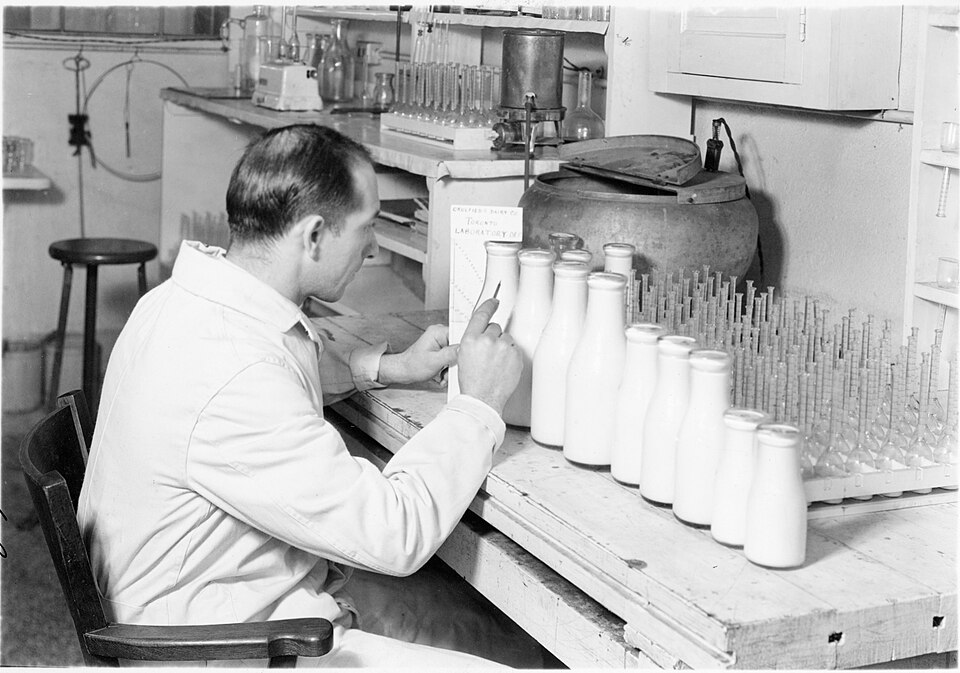
In Quebec, the retail price of regular fluid milk is regulated by the Régie des marchés agricoles et alimentaires du Québec. That is a separate mechanism from the one used to determine the farm-gate price.
Who sets the farm-gate milk price?
Milk pricing is applied across all ten provinces within a national framework. The Canadian Dairy Commission plays a central role.
Each year, the Commission reviews farm production-cost data, consults producers, processors, further processors, food-service representatives and consumers, and announces adjustments that serve as a reference for provincial authorities.
Provincial marketing boards then apply prices according to milk classes and their provincial or regional pooling rules.
The national formula: 50% production costs, 50% inflation
For most annual adjustments, the Canadian Dairy Commission uses a national pricing formula.
The formula gives a 50% weight to changes in the cost of producing milk and a 50% weight to changes in the Consumer Price Index.
For 2026, the national formula produced a 2.3255% adjustment, effective February 1. The Commission noted continued pressure from feed and labour costs.
How are production costs measured?
The Canadian Dairy Commission works with provinces on a national cost-of-production survey. The goal is not to reimburse every expense on every farm, but to build a representative picture of the cost of operating an efficient dairy farm.
Observed costs include feed, labour, energy, maintenance, buildings, machinery and other expenses required to produce milk.
Milk is paid according to its components
A farm is not paid only for the number of litres delivered.
- butterfat;
- protein;
- other solids, including lactose and minerals.
Milk composition therefore directly affects the value of a shipment. Two farms delivering exactly the same volume can receive different revenues if butterfat and protein levels differ.
This is also why dairy quota is expressed in kilograms of butterfat per day rather than litres.
Why does milk’s end use affect its value?
Milk does not have the same economic value in every product.
Processors use milk to make fluid milk, cheese, butter, yogurt, ice cream and food ingredients. Canada uses harmonized milk classes to distinguish these markets, and component prices vary according to the final use.
Some special classes used as ingredients in further processing are more closely tied to world prices, adding an international-market component to dairy revenues.
What is the butter support price?
The Canadian Dairy Commission also sets an annual butter support price. For 2026, it is $10.5662 per kilogram.
This is not the retail price of butter. It is the price at which the Commission buys and sells butter through seasonal balancing programs.
When production temporarily exceeds demand, the Commission can purchase and store butter. When demand increases, those stocks can return to the market.
What role do provinces play?
The general framework is national, but provincial marketing boards apply the prices.
In Quebec, Les Producteurs de lait du Québec administer collective marketing and apply pricing mechanisms agreed within the P5 and through processor agreements.
Farmers therefore do not negotiate individually with large processors. Conditions of sale are negotiated collectively and revenues are distributed according to the applicable rules.
The P5 and Quebec producer revenues
Quebec belongs to the P5 Eastern Canadian Milk Pool with Ontario, New Brunswick, Nova Scotia and Prince Edward Island.
These provinces pool a large share of revenues from different dairy markets. A farm’s income therefore does not depend directly on whether its physical milk happens to go to a cheese plant or a fluid-milk plant.
Why does a farm’s milk revenue vary from month to month?
Even when reference prices do not change, a farm’s return per hectolitre can vary because of:
- butterfat and protein levels;
- the mix of milk classes and markets;
- pooling adjustments;
- fees or deductions;
- milk quality;
- other market adjustments.
It is therefore misleading to speak of one fixed “price per litre” received by every farmer.
Does supply management guarantee income?
No. Pricing mechanisms aim to provide greater stability and account for the costs of efficient production, but they do not guarantee profitability.
A highly indebted or inefficient farm can still struggle, while a well-managed operation may perform better because of productivity, forage quality, herd management and investment choices.
Does a higher farm-gate price automatically raise the retail price by the same amount?
No.
The farm-gate price is only one component of the final retail price. A change at the farm can be absorbed, amplified or accompanied by cost changes in processing, packaging, transportation and distribution.
The Canadian Dairy Commission regulates the price of milk leaving the farm, not the final price of dairy products on store shelves.
Why is milk pricing so controversial?
Because it sits at the intersection of several interests.
Farmers need to cover costs and earn a reasonable return. Processors seek margins and competitiveness. Retailers manage their own costs and pricing strategies. Consumers want affordable food.
The Canadian system tries to balance these interests while avoiding farm-gate prices being determined solely by short-term swings in world markets.
That is one of the central features of supply management in Canada.
Key takeaways
The Canadian farm-gate milk price is not set arbitrarily by a single agency and is not the same as the retail price.
The Canadian Dairy Commission uses a national formula that gives equal weight to production-cost changes and inflation. Provinces then apply prices according to milk classes and components. Revenues from different markets are pooled, including through the P5 in Eastern Canada.
For the broader context, see Canada’s Dairy Sector.