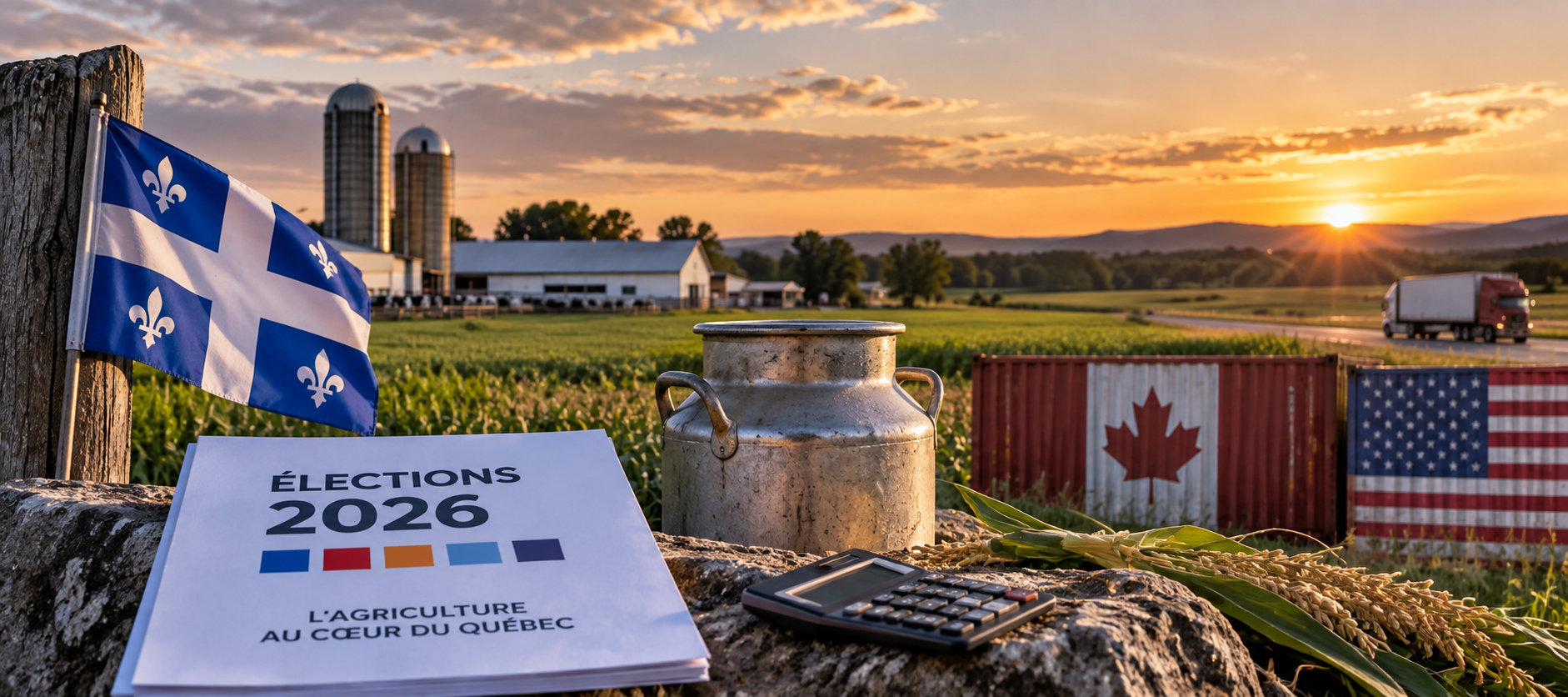
Three issues stood out to me this week: the agricultural commitments being made by Quebec’s political parties, the trade escalation now directly affecting the dairy sector, and the cost of agricultural credit. They are very different issues, but they have one thing in common: all three can directly influence decisions made on the farm.
Quebec parties put numbers behind their agricultural commitments
The election campaign reached an important stage this week as several parties moved from broad statements to specific, costed commitments. The Quebec Liberal Party announced $560 million over four years, the Parti Québécois at least $450 million over four years, Québec solidaire an additional $210 million per year for the MAPAQ along with a $500-million climate fund, while the CAQ presented $56 million for farm succession and measures aimed at reducing administrative burden.
The real point, however, is not simply to compare the totals. What matters is which measures can actually change something on farms: access to financing, succession, farmland protection, local purchasing, income support or less paperwork.
I have brought my analyses together on the page covering the agricultural proposals of Quebec’s political parties in the 2026 election, which will continue to be updated as new commitments are announced.
See the Quebec Liberal Party’s agricultural announcement and the Parti Québécois announcement.
Trade tensions are now directly affecting the dairy sector
Canadian counter-tariffs took effect on September 8 on $27.6 billion worth of U.S. imports, including dairy products and some agricultural equipment. The same day, the United States announced that certain Canadian dairy products will be excluded from the U.S. market beginning September 29, while others remain subject to additional duties.
The issue therefore moved this week from political threats and announcements to concrete measures affecting dairy trade and some equipment costs.
For now, I would rather remain cautious. I still do not know what the real consequences of these measures will be for our production. The announcements are significant, but we will need to see how they translate on the ground for producers before drawing conclusions.
See the federal list of U.S. products subject to counter-tariffs and the U.S. announcement concerning certain Canadian dairy products.
Agricultural borrowing costs remain under pressure
Farm Credit Canada notes that persistently high bond yields can limit the effect of a more accommodative monetary policy. For farms, that means the actual cost of financing can remain high even if the policy rate does not rise.
This is a very practical issue. A change of even a few points in financing costs can completely alter the economics of a new barn, a milking robot, a land purchase or a major refinancing.
What happens next is difficult to predict. In a context where tariffs imposed by Canada and the United States could themselves add to inflation, we might normally expect upward pressure on interest rates. On the other hand, the Bank of Canada could also want to support the economy and encourage investment if activity slows. Between inflation and the need to stimulate the economy, the direction agricultural borrowing costs actually take remains something to watch.
Read Farm Credit Canada’s analysis of tariffs and bond yields.
What to take away
This week was not dominated by a single major agricultural story, but by three sources of uncertainty that can weigh on producers’ decisions. Political parties are now proposing more concrete measures, but their real impact still has to be assessed. The trade war is beginning to touch the dairy sector directly, without anyone yet knowing how far the consequences will go. And financing remains expensive at a time when many farms need to invest to improve productivity.
In other words, the coming months may require as much caution in financial decisions as attention to political ones.
Leave a Reply