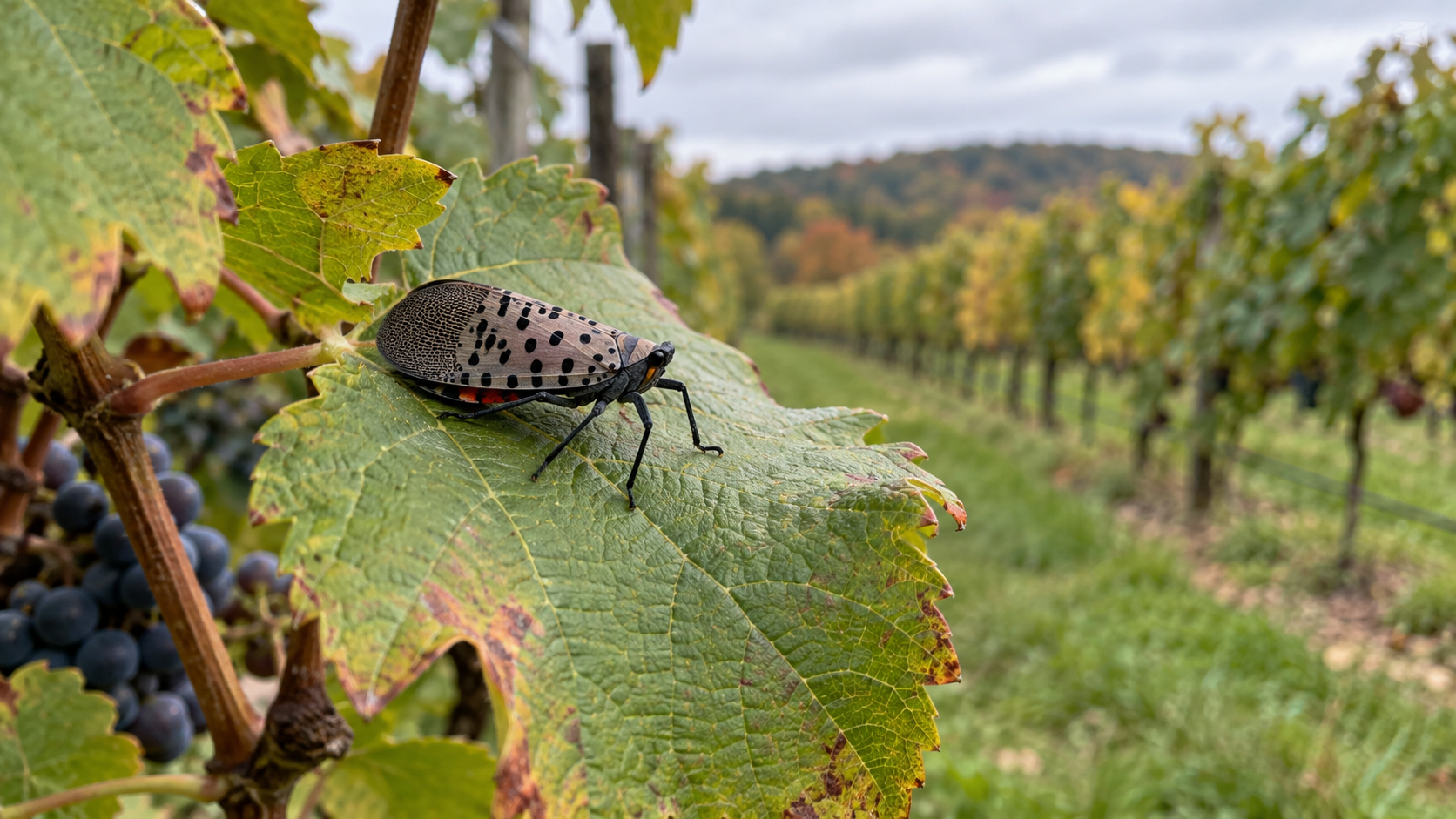
Canada has crossed a new threshold in its watch for spotted lanternfly. In September, the Canadian Food Inspection Agency confirmed a live insect in the environment during an official survey in Windsor, Ontario. That is more significant than finding a specimen on freight or a vehicle, but it does not yet mean the pest is established in Canada.
An official detection, not yet an established population
The CFIA classifies the Windsor case as a “detection.” In the agency’s terminology, that means a live spotted lanternfly was confirmed in the Canadian environment during an official survey. An established population would require evidence of a reproducing population. The agency says no established population has been confirmed in Canada.
The distinction matters. Live and dead lanternflies have been intercepted on goods and vehicles for several years, while some public reports could not be confirmed. In August 2026, a live specimen was intercepted at Saint-Bernard-de-Lacolle, Quebec. That interception does not prove the insect is established in the province, but it shows that the pathway into Canada remains active.
Vineyards and orchards have the most at stake
Native to Asia and present in the United States since 2014, spotted lanternfly feeds on the sap of many plants. The CFIA considers it a potential threat to grape, fruit tree and forestry industries. Grapevines are among its important hosts, along with apple, plum, cherry and peach trees and several forest species.
Its ability to hitchhike adds to the risk. Females can lay egg masses on smooth surfaces such as stone, outdoor furniture and vehicles, allowing the pest to travel long distances without moving on nursery stock. Canada has regulated spotted lanternfly as a plant pest since 2018.
Climate can amplify the risk without carrying the insect
This particular arrival cannot be attributed to climate change. Human activity is the main pathway for long-distance introduction and spread: eggs and insects hitchhike on goods, vehicles, trailers, firewood and outdoor furniture. Climate did not carry the insect to Windsor.
It can influence what happens next. US Forest Service research found that spotted lanternfly can tolerate more variable temperature regimes than previously understood and that its potential climatic range may include areas once considered too cold. Milder winters and longer warm seasons can therefore make establishment and expansion more likely, even though this individual detection cannot be blamed on warming.
That is one more consequence farmers may have to manage. Vineyards face the most immediate threat today, but tomorrow another invasive species could affect any farm sector. As with other recent crop pest and disease signals in Ontario and Quebec, surveillance and biosecurity matter well beyond the producers already affected.
Early detection remains the practical priority
The Windsor finding does not mean Canadian vineyards are infested. It does warrant closer surveillance in wine-growing regions and along transportation corridors. The CFIA asks Canadians to report suspected specimens. At this stage, prompt reporting and effective surveys will determine whether the pest can be contained before it becomes established.
Sources: Spotted lanternfly observations in Canada, CFIA; scientific fact sheet on Lycorma delicatula, CFIA; spotted lanternfly spread pathway, USDA APHIS; study of its potential climatic range, US Forest Service.
Leave a Reply