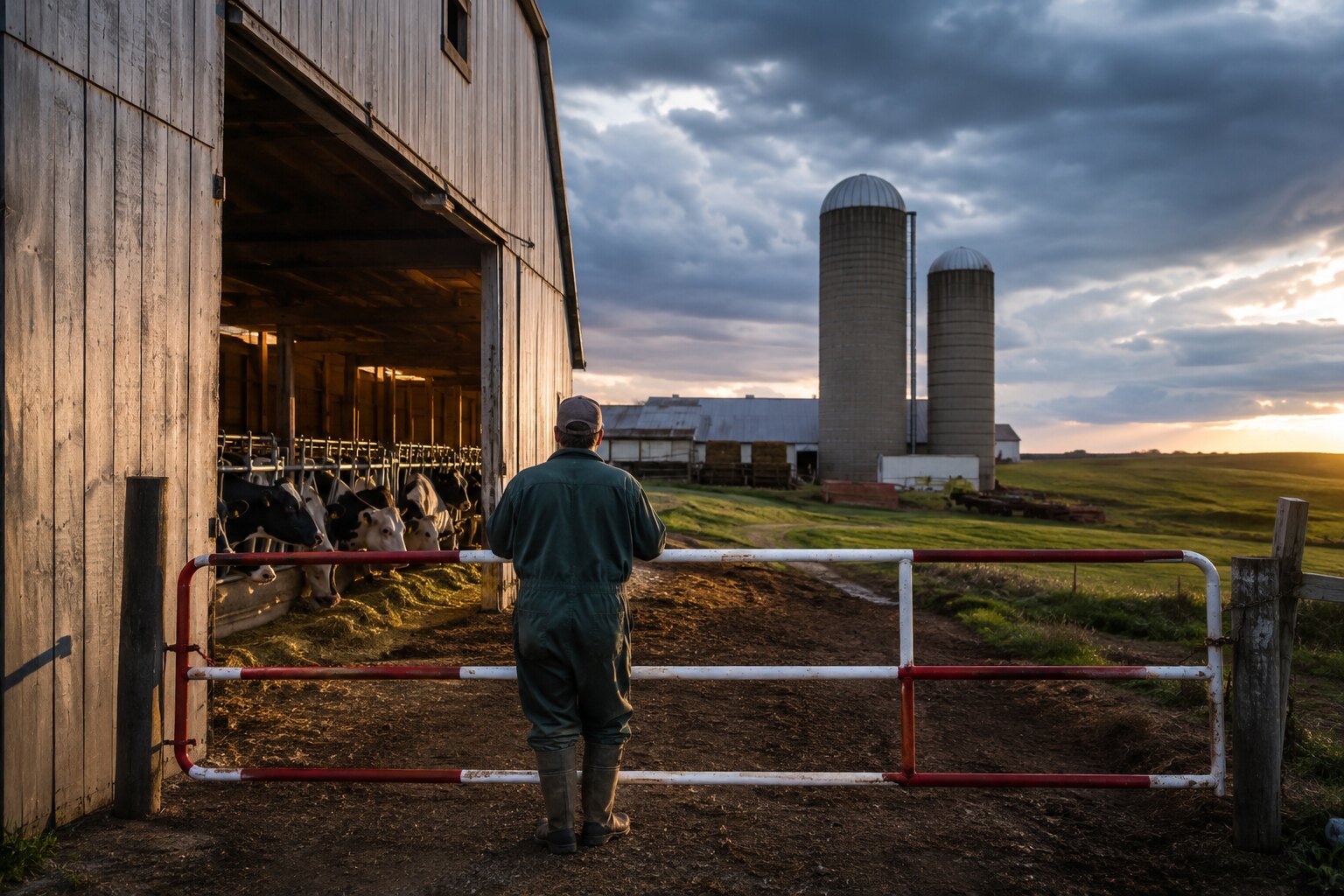
Canada’s supply management system has survived decades of trade negotiations, several changes of government and repeated campaigns predicting its imminent demise. It is still standing, and since 2025 it has even benefited from unprecedented legislative protection. Yet rarely has the system been placed so directly at the centre of a trade power struggle.
The threat no longer takes only the form of an explicit demand for abolition. It appears through a succession of concessions, technical challenges and tariff pressure that can, piece by piece, reduce the share of the market actually reserved for Canadian producers. This gradual erosion, more than any sudden deregulation, is now the main danger.
A system that organizes the market rather than subsidizing it
Supply management rests on three pillars: matching production to Canadian demand, a pricing mechanism intended to cover the costs of efficient production and import controls. It applies to dairy, chicken, turkey, table eggs and broiler hatching eggs. The Farm Products Council of Canada describes it as a way to avoid both overproduction and shortages, provide fair returns to producers and maintain a stable supply.
The principle is straightforward: produce according to what the domestic market can absorb. In non-quota sectors, a good year can quickly become bad news if all producers expand at the same time and push prices down. Supply management reduces this classic cycle of expansion, surplus, price collapse and consolidation.
The model does not guarantee wealth. Farms remain exposed to feed, energy, labour, building and financing costs. It does, however, provide predictability that supports long-term investment without relying as heavily on public payments when markets collapse. In 2024, supply-managed sectors generated more than C$15 billion in farm cash receipts, according to Agriculture and Agri-Food Canada transition materials.
The immediate threat: the power struggle with the United States
The review of the Canada-United States-Mexico Agreement was already expected to bring supply-managed agriculture back to the forefront. Washington has long criticized Canada’s over-quota tariffs, dairy tariff-rate quota administration and certain pricing mechanisms. The 2026 U.S. National Trade Estimate Report maintains those complaints.
Canadian tariffs that can exceed 200% are often presented as proof of a completely closed market. That description is incomplete. Those rates mainly apply to imports above negotiated quota volumes. Within those quotas, significant quantities of foreign products already enter Canada at reduced or zero tariffs. Federal data on tariff-rate quotas for supply-managed products show separate access commitments under the World Trade Organization, the CPTPP and CUSMA.
By the summer of 2026, the confrontation had become more concrete. The U.S. administration linked the treatment of American dairy exporters to a new tariff measure against Canada. In a July 20, 2026 statement, the U.S. Trade Representative invoked Section 338 and announced additional duties while specifically criticizing Canada’s treatment of the U.S. dairy sector.
Supply management has therefore become a bargaining chip in a dispute that also touches automobiles, alcohol, public procurement and other Canadian policies. The danger is clear: even if Ottawa refuses to abolish the system, it could face pressure to grant more market access in exchange for concessions elsewhere.
The erosion began long ago
Canada preserved the architecture of supply management in its major trade agreements, but it gave up part of its domestic market in each of the last major negotiations. The agreement with the European Union, the Comprehensive and Progressive Agreement for Trans-Pacific Partnership and CUSMA all created or expanded import quotas.
Each additional access commitment may look limited on its own. Taken together, they represent sales Canadian farms can no longer make. The problem is structural: domestic demand does not automatically rise to offset imports. When foreign products take a larger share of the market, Canadian production must fall or grow more slowly.
The federal government itself acknowledged these losses by creating compensation programs for producers and processors. Those payments helped affected businesses invest, but temporary compensation does not replace a market lost permanently. It mainly confirms that trade concessions carry a real cost.
The CPTPP illustrates the mechanism well. Canada granted permanent quotas for dairy, poultry and eggs, phased in over time and set to expand. The official summary of the agreement says market access was granted while the three pillars of supply management were maintained. That is legally true, but economically, the import-control pillar can be weakened without disappearing altogether.
Bill C-202: a real shield, but not an absolute guarantee
Since June 26, 2025, Bill C-202 has prohibited the Minister of Foreign Affairs from entering into certain trade commitments that would increase tariff-rate quotas on supply-managed products or reduce over-quota tariffs. This is a major change: protection of the system no longer depends only on a political promise repeated at every negotiation.
The law sharply reduces the room available to a Canadian negotiator who might otherwise trade away more dairy, poultry or egg market access for gains in another sector. The government says this is consistent with its policy of defending all three pillars, as explained in Global Affairs Canada briefing documents.
But no ordinary statute is irreversible. A future Parliament can amend a law. Commercial pressure can also shift toward areas the law protects less directly: quota-allocation rules, composition standards, product classifications, import permits or pricing policies. The battle can therefore become more technical without becoming less important.
Critics of supply management argue that C-202 removes a bargaining chip from Canadian negotiators in advance. That criticism deserves consideration, but it also reveals the law’s real purpose: to stop supply-managed farms from repeatedly serving as trade currency for other industries. After three major agreements that gave away market access, drawing a line is hardly excessive.
Technical challenges: opening the market without abolishing the system
Recent dairy disputes have not necessarily targeted the elimination of Canadian production quotas. They have focused mainly on how Canada allocates import quotas. The United States challenged the share reserved for Canadian processors, arguing that the method limited commercial opportunities for U.S. exporters.
That may sound administrative, but the consequences can be substantial. A quota can exist on paper; allocation determines who can use it, which products enter and when. Changing those rules can increase competition in specific parts of the Canadian market without formally reopening the entire agreement.
The same logic applies to product categories and ingredients. In a food industry where milk proteins, preparations and processed products cross borders in many forms, a regulatory definition can matter as much as a tariff. Defending the system therefore requires constant technical expertise, not just broad political declarations.
Domestic pressure: food prices, concentration and the battle over the narrative
Supply management is also vulnerable politically within Canada. During periods of food inflation, it is tempting to blame the price of milk, eggs or chicken entirely on farm income. Yet the farm-gate price is only part of the retail price. Processing, transportation, packaging, distribution and retail margins all intervene between the barn and the checkout.
The system must still accept transparency. Its defenders gain nothing by pretending it is perfect. Entry costs tied to quota can complicate farm transfers and new entrants. Rules must evolve with consumption. Producers must also demonstrate progress on animal welfare, the environment and productivity.
But abolishing supply management would not eliminate Canadian production costs or concentration in processing and retail. It would mainly shift more risk onto farms and expose the domestic market more directly to foreign surpluses. In countries that support producers differently, assistance often comes straight from the public treasury. Consumers then pay part of their food bill as taxpayers rather than at the grocery store.
Why defending it goes beyond farmers
The debate is not only about quota values or the income of a few thousand farms. It concerns Canada’s ability to maintain production across its territory, close to consumers and subject to Canadian standards. In its National Food Security Strategy, Ottawa now presents supply management as a fundamental element of Canadian self-sufficiency in milk, eggs and poultry, as well as rural vitality.
The pandemic, animal diseases, trade wars and logistics disruptions have shown that food supply cannot be reduced to the lowest price available on the world market on a given day. Lost production capacity cannot be rebuilt instantly. Geographically distributed farms are food infrastructure as much as they are an economic sector.
The stability provided by the system also helps processors plan supplies and allows consumers to count on regular production. It reduces the violent swings between surpluses that devastate farmers and shortages that raise costs for the public.
What to watch now
The first line of defence will be the concrete application of C-202 during CUSMA discussions. Ottawa will have to resist not only requests for additional access, but also equivalent concessions disguised as technical changes.
The administration of existing quotas will also need close attention. Canada must respect the agreements it has signed or risk adverse rulings and retaliation. But respecting negotiated access does not mean offering more than was agreed.
Finally, farm organizations will need to explain the system more effectively to the public. The phrase “300% tariffs” is politically powerful because it is simple. The answer cannot merely be that it is misleading. It must explain volumes already imported, the difference between in-quota and over-quota tariffs, the composition of retail prices and the forms of farm support used elsewhere.
An agricultural policy choice, not an anomaly to apologize for
Supply management is not an accidental relic. It is a collective policy choice: match production to demand, pay prices that support viable domestic production and prevent the Canadian market from becoming an outlet for subsidized surpluses from major agricultural powers.
Its main weakness today lies in accumulation. One small concession, then another; one technical change, then a new interpretation; one temporary compensation payment for a market lost forever. The system can keep its name and institutions while slowly being hollowed out.
Canada’s legislative shield therefore arrives at a decisive moment. It does not remove the need to negotiate carefully, modernize the model or respond honestly to criticism. It does, however, establish a reasonable principle: dairy, poultry and egg producers should no longer be the automatic bargaining chip in every trade agreement.
The question is no longer only whether supply management will survive. It is whether Canada is prepared to defend it in the details, where most of the battle is now being fought.
Sources and references
- Farm Products Council of Canada — Supply management
- Parliament of Canada — Bill C-202, Royal Assent
- Agriculture and Agri-Food Canada — National Food Security Strategy
- Global Affairs Canada — Position on protecting supply management
- USTR — National Trade Estimate Report 2026
- USTR — Tariff measures targeting Canada, July 20, 2026
- Global Affairs Canada — 2026-2027 tariff-rate quotas
- Global Affairs Canada — CPTPP agricultural outcomes
Leave a Reply