
Category: Opinions

  • The Problems With Dairy Quota

    The Problems With Dairy Quota

    Before getting into this, I want to make one thing clear: I am absolutely not opposed to supply management. It is a useful system that supports a major pillar of Canadian agriculture, with effects that extend beyond dairy alone. I will not get into poultry or eggs because those are not sectors I know well.

    That does not prevent me from taking a critical look at the system. At its core, supply management helps preserve the dairy sector by ensuring that production within allocated limits has a market. But it also has major flaws that, in my view, need to be named.

    Three important problems

    I have identified three issues that deserve serious attention:

    • the $24,000 quota price ceiling;
    • the right not to produce quota that is held;
    • the lack of, and opposition to, a quota-rental mechanism.

    I will explain why I think each of these creates problems and suggest ways they could be addressed. I am not going to change the system by myself. Dairy Farmers of Quebec and the Canadian dairy organizations function democratically. By throwing this small stone into the pond, I hope to contribute to the discussion.

    The $24,000 price ceiling

    The ceiling on the price of one kilogram of quota was set at $25,000 jointly by Quebec and Ontario in 2010. The goal was to limit price increases in an asset that was, and still is, a barrier to entering dairy production. A few years later, in 2016, the price was lowered to $24,000 per kilogram following changes that transferred non-saleable quota into saleable quota and diluted its value.

    Although a price cap may sound reasonable, it produces unwanted side effects.

    Basic economic principles tell us that a price ceiling increases demand in a market where supply is limited. Leaving that ceiling unindexed over time makes the problem even worse. If the price had merely tracked inflation since 2016, it would now be around $31,000 per kilogram. Had it been indexed from the start in 2010, it would be above $35,000.

    That is one reason why farms can now buy only tiny fractions of a kilogram of quota in many monthly exchanges. Supply remains structurally below demand. Which leads to the second problem.

    The right not to produce

    Many dairy farms want to expand. New barns are built, old ones are renovated and better production methods are adopted. Even with the same number of cows, milk output can increase, and with it the need for quota that allows that additional production to be marketed.

    While Quebec dairy producers collectively have an obligation to fill the production target allocated to the province, an individual farm can accumulate quota without producing it.

    The explanation is straightforward. Because farms can often buy only fractions of a kilogram each month, a business planning an expansion starts accumulating production rights years in advance. Over time, a farm can build up 10, 20 kilograms or more before the project is ready.

    Across Quebec, hundreds of kilograms can therefore sit in reserve without being produced. I do not blame the farms that make that choice. Who is going to invest millions in a new building that could sit partly empty for months because quota is unavailable?

    There is also a certain amount of quota that remains unproduced for other reasons. Consecutive increases in production rights have followed growth in overall Canadian demand for milk and dairy products. Some farms keep those rights in anticipation of future projects, while others simply leave them unused.

    The lack of a rental mechanism

    There is essentially one way to trade dairy quota: buying and selling. Most provinces participating in the system do not allow ordinary rental, although some temporary transfers are possible.

    A farm that accumulates quota for a future expansion can therefore end up holding a significant amount of dormant production rights in its asset portfolio. One unintended consequence is that extra quota may need to be issued collectively to make sure Quebec reaches its production target.

    Large sums of money are frozen in the system. Ten kilograms of quota represent $240,000 tied up in an asset that produces no milk revenue and no interest income. Worse, inflation slowly erodes the real value of that capital.

    There are several arguments against rental. Some are valid, while others strike me as more self-interested. Two of the most common are:

    • the fear that farms would buy quota solely to rent it out;
    • the concern that rental would financially reward poor producers.

    Rental rules could be designed to prevent quota from being purchased purely as a rental investment. It could be limited to a percentage of quota owned, or permitted only for a defined period when a producer is accumulating quota for a major expansion.

    I do not find the second objection convincing. If a producer, good or bad, can rent out part of an unused production right, that can benefit the system as a whole. Dormant quota is finally put back into production.

    My proposals

    The price ceiling

    It is long past time to start indexing the price of dairy quota more aggressively. Every year we fail to do so makes the imbalance worse. If the ceiling increased modestly each year, slightly above the previous year’s inflation rate, the system could begin catching up. Accumulating quota far in advance would gradually become less attractive, and the quantities allocated in each monthly exchange could increase. Buying years ahead would lose some of its appeal, and more quota purchased would actually be produced.

    The right not to produce

    Not producing quota should become a temporary situation, not a structural outcome. We collectively have an obligation to fill our production target, and that should ultimately be reflected at the farm level.

    Above a certain percentage of unproduced quota, that production right could be temporarily redistributed across farms. Not confiscated, not forcibly sold, simply redistributed until the owner is ready to use it.

    Or we eventually move to the final option.

    Allow rental

    I understand why many farms hold dormant quota. As explained above, they are preparing expansions. The other cases likely represent a smaller share of the unproduced total.

    A farm preparing an expansion and buying quota in advance should be able, for a limited period, to rent out that production right. Not partially, not for a few days here and there. Rent it out fully, then take it back when the farm is ready.

    There are farms ready to produce but constrained by the system. There are quotas sitting idle for months or years that could be used immediately. Leaving production rights dormant because of ideological rigidity is harmful to everyone.

    Naming the blind spots

    The dairy quota system is neither absurd nor something that should be discarded. It has delivered remarkable stability in a sector that, elsewhere, has often been sacrificed to market volatility. But that very strength makes its rigidities harder to correct.

    The frozen price ceiling, the right not to produce and the inability to rent are not isolated anomalies. Together, they protect quota value while restricting its circulation and use. Until those blind spots are named clearly, the same debates will keep coming back without ever being resolved.

    Thinking about these issues is not an attack on supply management. It is a way of taking its long-term future seriously. A durable system must be able to adapt, not only under pressure from crises, but through a clear-eyed look at its own limits.
  • Sylvain Charlebois vs. Supply Management: The Free Market He Is Selling Does Not Exist

    Sylvain Charlebois vs. Supply Management: The Free Market He Is Selling Does Not Exist

    Sylvain Charlebois deserves credit for forcing a debate about supply management. But by increasingly portraying it as the near-universal cause of the dairy sector’s problems, he ends up selling Canadians a solution, the “free market,” that barely exists anywhere in the global dairy industry.

    For years, the Dalhousie University professor has described supply management as a rigid, opaque system that is costly for consumers and responsible for the decline in the number of dairy farms. In his more recent columns, the language has become even harsher. He argues that the system is “killing” Canada’s dairy sector, isolating the country and protecting a comfortable rent for producers.

    That language is effective. It creates an easy villain. But it greatly oversimplifies a much more complex economic reality and consistently minimizes the central question: what would actually happen if Canada abandoned supply management?

    The farm-gate price is not the grocery-store price

    One of the most persistent shortcuts in this debate is to directly associate supply management with the price paid by consumers. Yet the federal government itself notes that, in dairy, it is the price paid to farmers that is regulated. With a few provincial exceptions for fluid milk, retail dairy prices are not regulated.

    Between the farm and the shelf are processing, packaging, transportation, distribution and retailer margins. Presenting the farm-gate price as the main barrier to affordability therefore shifts attention away from the rest of the chain, precisely where corporate concentration and market power are often strongest.

    Supply management is not a blank cheque handed to farmers. The milk price is based in part on a national cost-of-production survey. The objective is to allow an efficient farm to cover its costs and earn reasonable compensation rather than forcing farm families to absorb every market collapse on their own.

    The disappearance of farms is not proof against the system

    Sylvain Charlebois often points to the decline in the number of dairy farms in Canada since supply management was introduced. The number is real. The conclusion he draws from it is much less convincing.

    Consolidation is also happening in the United States, where there is no Canadian-style supply management. The U.S. Department of Agriculture has long documented dairy production becoming concentrated in fewer, larger operations attracted by lower unit costs. Mechanization, rising milk yield per cow, building costs, labour shortages and succession challenges are reshaping agriculture across developed countries.

    We can certainly debate quota prices, access for young farmers or whether the system encourages enough innovation. But blaming consolidation on supply management confuses a global trend with a uniquely Canadian policy.

    The dairy “free market” is heavily supported by government

    This is the biggest blind spot in Charlebois’s argument. U.S. dairy farmers are not simply left to market forces. They have access to the federal Dairy Margin Coverage program, which makes payments when the margin between milk prices and feed costs falls below certain levels. For 2026, the USDA forecast includes significant payments under this program.

    The European Union also monitors its dairy market, provides direct payments through the Common Agricultural Policy and retains public intervention and private-storage mechanisms to respond to imbalances. When prices collapse, governments intervene. When surpluses accumulate, they buy, store, subsidize or compensate.

    The Canadian difference is therefore not that Canada supports farmers while everyone else lets the market operate freely. It is that Canada organizes production around domestic demand and relies more heavily on market revenue, instead of periodically socializing losses through public programs.

    Charlebois’s own report contradicts some of his harshest claims

    Perhaps the most convincing criticism of his recent columns can be found in his own 2020 report, Supply Management 2.0, published with colleagues from Dalhousie University and the University of Guelph.

    The report says that immediate dismantling is not a viable solution. It acknowledges that U.S. milk could flood the Canadian market, that the domestic industry could become dependent on imports and that consumers could even end up paying more after the system was abolished. Most importantly, the report recognizes that a solution that appears efficient in a pure free-market model is not necessarily optimal when farm livelihoods, rural economies and Canadian values are considered.

    Those nuances matter. Yet they are often missing when Charlebois now says supply management is “killing” the sector or damaging Canada’s international credibility. Between the academic analysis and the public columns, conditional language often disappears in favour of a punchier slogan.

    Transparency can improve, but it is not nonexistent

    Charlebois is right about one thing: a system that organizes a national market has to continually earn public trust. Pricing mechanisms, quota decisions and the effects of trade policy need to be explained in much more accessible language. Farm organizations have sometimes spoken mainly to their members, leaving opponents to define the system for the broader public.

    But calling the system opaque as though its rules were secret is excessive. The Canadian Dairy Commission is a Crown corporation accountable to Parliament. Prices, formulas, adjustments and decisions are governed by public laws and regulations. Producer organizations also point out that pricing formulas include production costs and inflation measures and that changes are publicly announced.

    More transparency and better communication should be demanded. But the need for improvement should not be turned into an accusation of a hidden rent.

    Reform does not require dismantling

    Supply management is not perfect. The cost of entry for new farmers is real. Rules can slow some forms of innovation. Successive trade concessions have made the system more complex. Farmers also have to respond clearly to expectations around animal welfare, the environment and productivity.

    But none of those criticisms proves that Canada would be better off fully exposing domestic production to subsidized surpluses from neighbouring countries and then replacing market stability with government payments whenever prices collapse.

    The debate Sylvain Charlebois is pushing deserves better than his own slogans. Yes, supply management must evolve. Yes, it should be more transparent and better adapted to the next generation. No, it is not the sole cause of every problem in Canadian dairy. And no, dismantling it would not magically give consumers cheaper milk, farmers higher incomes and Canada new export markets.

    In a world where major agricultural powers subsidize, protect and intervene heavily, keeping a system that aligns production with demand is not a rejection of economics. It is an agricultural-policy choice. It can be criticized. But before condemning it, we should compare this real system with the real systems used elsewhere, not with an imaginary free market.

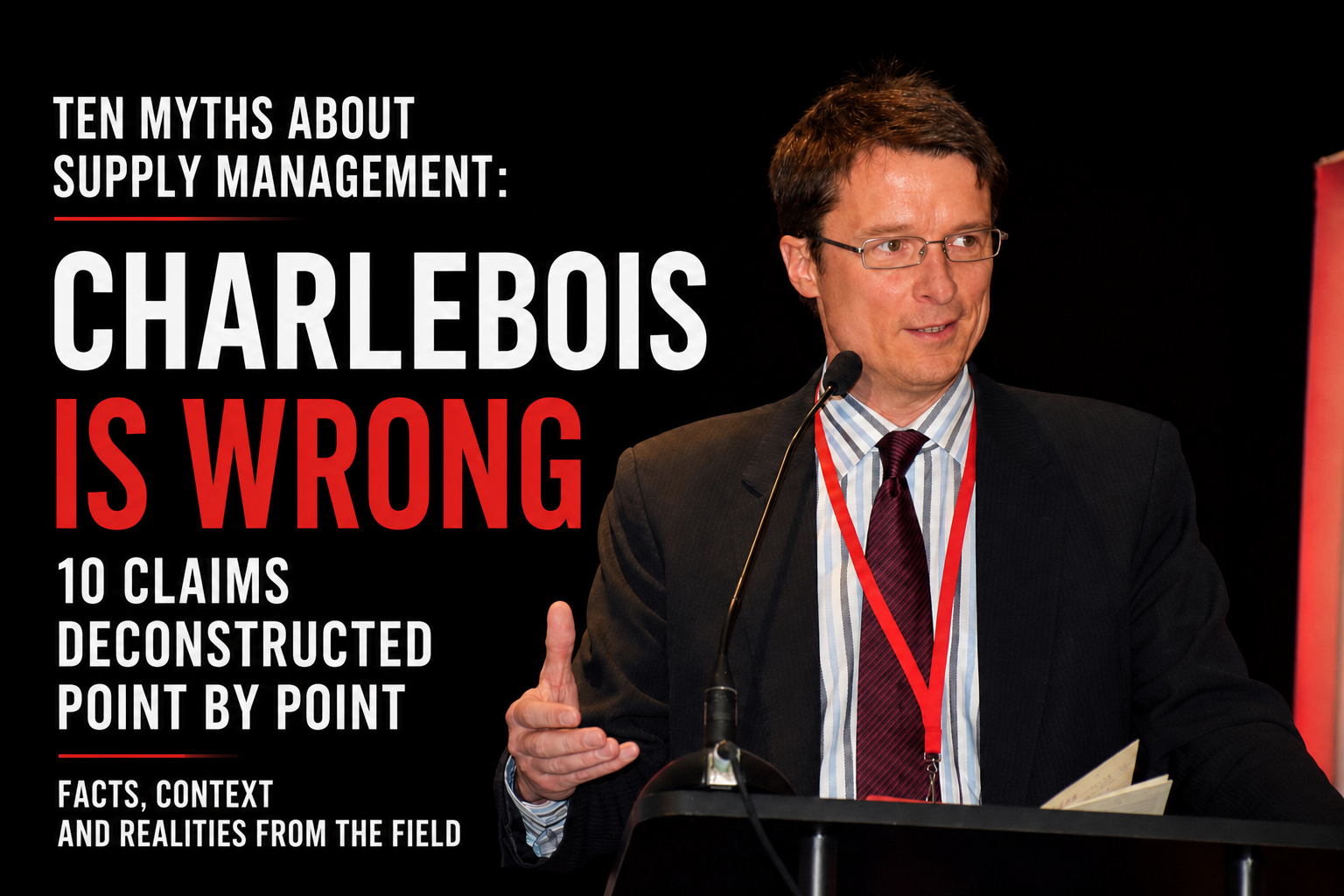
    Since then, Sylvain Charlebois has put forward ten “myths” about supply management. I examined them one by one in my detailed analysis of his ten supply-management myths.

    Further reading on supply management

    Sources

    Photo: Janvez, Wikimedia Commons, CC BY-SA 4.0.

  • Sylvain Charlebois’s 10 Myths About Supply Management: What He Gets Right, What He Oversimplifies, and What He Leaves Out

    Sylvain Charlebois’s 10 Myths About Supply Management: What He Gets Right, What He Oversimplifies, and What He Leaves Out

    On August 14, Sylvain Charlebois published “Ten myths Canadians need to stop believing about supply management”. The piece is more nuanced than some of his previous columns. On a few points, I even agree with him. On others, however, the facts presented are only partly accurate, stripped of essential context, or used to support conclusions they do not actually demonstrate.

    That is probably what disappoints me most. Sylvain Charlebois is not just any commentator: he is a professor, holds a research chair, and is regularly presented in the media as an expert on food policy. It is therefore reasonable to expect a particularly high level of rigour from him. Yet several times, the starting facts are not necessarily false, but the missing context, the conflation of different concepts, or the conclusions drawn from them give readers a distorted picture of reality.

    Rather than answer with ten opposing slogans, let’s look at his ten “myths” one by one.

    1. Are dairy farmers millionaires?

    Yes, if you add up the value of the land, buildings, herd, machinery and quota, many dairy farms are worth several million dollars. But a six-million-dollar farm is not a six-million-dollar bank account.

    The value of those assets, by itself, tells us nothing about a farmer’s disposable income, debt load, reinvestment needs or the return earned on all that tied-up capital. That is precisely the distinction I explored in Dairy farmers are millionaires. Yes, but….

    Charlebois nevertheless raises a real issue: high asset values make it harder for new farmers to enter the sector and for farms to be transferred to the next generation. But equating productive assets with personal wealth remains a shortcut.

    2. Does supply management protect the family farm?

    No, supply management has not prevented consolidation. The number of Canadian dairy farms has fallen sharply since the system was created. But that figure alone absolutely does not prove that the system failed to protect family farms. To know that, we have to compare what happened elsewhere.

    Between 2014 and 2024, Canada went from roughly 12,007 dairy farms to 9,256, a decline of 22.9%. Over the same period, the United States went from about 44,809 licensed dairy herds to 24,811, a decline of 44.6%. The proportion of farms that disappeared south of the border was therefore almost twice as high.

    This comparison does not prove that supply management alone explains the difference. The two countries have different farm structures, markets and policies. It does show, however, why simply counting the number of Canadian farms cannot serve as proof against the system. The data are instead consistent with the idea that more stable farm income can slow consolidation, even if it cannot stop it.

    3. Do Canadian dairy farmers receive no subsidies?

    It depends on what we call a subsidy. Charlebois groups together compensation payments, tariffs, import restrictions, administered prices and various public programs. In a broad economic sense, all of these can be described as support. But they are not equivalent mechanisms.

    A tariff is not a government cheque. An administered price is not a budget expenditure. And compensation paid because the government permanently gave up part of the domestic market in a trade agreement is not the same thing as a permanent program that tops up farm income every year when market prices collapse.

    The contrast with the United States remains important. American dairy farmers have access to federal programs such as Dairy Margin Coverage when their margins become insufficient. Canada chose a different mechanism: match production to demand and derive most farm income from the marketplace.

    Another shortcut deserves attention. In his “ten myths” article, Charlebois refers to a national dairy marketing budget approaching $200 million while discussing the “dairy lobby.” But that does not mean $200 million is being spent on political lobbying. Producer-funded money supports advertising, promotion, market development, education and nutrition programs, sponsorships, research and other industry initiatives. As in many other industries, only part of that activity is directly related to political representation.

    4. Do trade agreements make every dairy farmer lose money?

    Charlebois emphasizes that individual farmers were not required to submit financial statements proving a farm-specific loss before receiving compensation. That is true. But that was not what the program was designed to measure.

    The Canadian government permanently granted foreign competitors access to a portion of the Canadian dairy market. Compensation was then distributed in proportion to quota held, meaning according to each farm’s share of production capacity in that market. A farmer holding twice as much quota did not receive the same cheque as a smaller producer: the compensation was proportionally larger.

    That approach strikes me as about as fair as it could reasonably have been. The loss is structural and collective, not simply a decline in accounting income observed in a given year. Quota is precisely the instrument that allocates each producer’s share of the Canadian market.

    It is also worth remembering that farmers themselves finance the promotion and development of that market through levies tied to their production. Advertising, educational programs, market development, sponsorships, research and other initiatives are funded collectively. When a government then decides to permanently give away part of the market that producers helped build, compensating farms in proportion to their market share is anything but arbitrary.

    5. Would ending supply management automatically lower prices?

    On this point, Sylvain Charlebois and I agree. Ending supply management would not guarantee lower grocery prices. He acknowledges that himself in his ten myths.

    The farm-gate price of raw milk is only one component of the final retail price. Processing, energy, packaging, transportation, equipment, distribution, wages and benefits, including in plants with unionized workforces, as well as retail margins would all still exist if the price paid to farmers went down.

    There is also an important evolution in his public position. In another article published August 19 by La Vie agricole, following a discussion with farmer Frédéric Poulin and Simon Bégin, the reported conclusion is that none of the three wants to abolish supply management. Charlebois instead talks about reform. That is an important distinction, and one I readily acknowledge: our disagreement is therefore more about the diagnosis and the proposed reforms than about outright abolition.

    6. Do farmers alone bear the cost of dumped milk?

    Here, we have to distinguish between two situations that Charlebois’s wording tends to blur together.

    When an individual farm exceeds its quota and has to dispose of milk that cannot be marketed, the loss is borne directly by that farm. The dumped milk is not reimbursed through some collective mechanism.

    When there is instead a collective market surplus, the situation is different. Costs can be shared among producers through pooling mechanisms. In that case, yes, the loss is pooled. But it is still borne collectively by producers, not mysteriously transferred to someone else.

    We should also avoid speaking as though every surplus necessarily means whole milk being poured down the drain. Imbalances often involve milk components, particularly non-fat solids, which need outlets distinct from butterfat.

    7. Is milk dumping unavoidable?

    As in virtually every agri-food industry, losses exist. No real-world system uses 100% of every litre produced perfectly, every day of the year. The relevant question is therefore less whether waste exists than how large it actually is.

    On this point, official data paint a far less dramatic picture than some headlines suggest. Agriculture and Agri-Food Canada states that in 2023, more than 99% of raw milk produced on Canadian farms was processed and notes that milk disposal is rare in Canada. In other words, the system already processes virtually all the milk produced.

    We should be especially cautious with estimates claiming that several billion litres have been “dumped” since 2012. Those figures do not come from a national registry adding up actual measured volumes poured down drains. They are based on an estimate of the gap between theoretical production calculated from cow numbers and average yield, and the volumes actually sold to processors. That gap can include a variety of things, including milk fed to calves, milk that cannot be marketed, normal losses and methodological differences.

    That research can certainly raise a legitimate question about the quality of available data. But an indirect estimate of “missing milk” should not be presented as a precise measurement of billions of litres deliberately dumped.

    8. Has Canada fully complied with CUSMA?

    The disputes have to be distinguished from one another. The United States won an initial dispute over the way Canada reserved certain shares of its tariff-rate quotas for processors. Canada subsequently changed its rules.

    Washington challenged the revised system again. This time, in 2023, the majority of the panel rejected the main U.S. challenges. In other words, the fact that the United States is dissatisfied with Canada’s implementation of CUSMA does not automatically mean Canada is violating the agreement.

    Our interpretation of the current rules was therefore indeed upheld on important elements of the second dispute. I explored this issue in more detail in Closed dairy market? The numbers say otherwise and in my recent articles on U.S. demands.

    9. Does supply management guarantee food security?

    I would replace the word “guarantee” with contributes significantly to. No system can by itself guarantee food security in the face of a major animal-disease outbreak, a natural disaster, a logistical breakdown or an international crisis.

    But supply management contributes directly to the stability of our production capacity. It seeks to avoid both extremes: chronic surpluses that collapse prices and drive farms out of business, followed by shortages that send prices soaring and force us to rebuild lost production capacity quickly.

    Food security does not mean autarky. The fact that farmers use imported tractors, veterinary medicines or certain inputs does not make domestic dairy production capacity irrelevant. A farm that disappears cannot be restarted in a few months: it requires a herd, buildings, land, equipment, capital and labour. Maintaining that infrastructure in Canada is clearly one component of food-system resilience.

    10. Does reform mean abolishing the system overnight?

    On this, we agree again: reform means reform, not abolition. Keeping the system entirely unchanged and abolishing it immediately are not the only two options. That willingness to reform without necessarily abolishing the model also emerges from the discussion reported by La Vie agricole.

    The problem lies instead in the concrete content of the proposed reform. In his ten myths article, Charlebois proposes, among other things, a 15-year transition, lower industrial milk prices, easier entry for new farmers, more processing and innovation, and a gradual approach to quota values.

    But the measures that directly affect farms have one thing in common: they place most of the cost of the transition on producers. Lowering industrial milk prices reduces farm income. Reducing or gradually eliminating quota value simultaneously hits a major asset on farm balance sheets. Making it easier for new producers to enter without explaining how additional production would be allocated could also dilute the economic value of existing production rights.

    A reform of this kind could cause exactly the phenomenon Charlebois criticizes the current system for failing to prevent: accelerated consolidation. The most indebted farms, smaller farms and farms that have recently invested would be the most vulnerable. Better-capitalized operations could more easily absorb lower income, buy the assets of those leaving the sector and grow larger.

    A credible reform therefore has to answer a very simple question: who pays? If lower milk prices and the loss of quota value are absorbed mainly by producers, then the reform also needs to explain why that transition would not trigger a mass exit of farms.

    Criticize supply management, yes. Oversimplify reality, no.

    Supply management is not perfect. The cost of entry for the next generation, quota values, processing capacity, transparency, surpluses of certain milk components and industrial competitiveness are all real issues. Farmers and their organizations have to be willing to discuss them.

    But criticism deserves the same scrutiny. A farm worth several million dollars does not necessarily mean a farmer has millions in liquid wealth. The decline in the number of Canadian farms cannot be assessed without noting that consolidation has moved much faster in the United States. Trade compensation was not distributed equally at random: it was calculated according to quota held. More than 99% of Canadian raw milk is processed. And a U.S. challenge under CUSMA does not automatically amount to a Canadian violation.

    I have no problem with Sylvain Charlebois wanting to reform supply management. On some points, I even share his diagnosis. But when an academic with such a prominent public platform sets out to “debunk myths,” he should also accept that his own shortcuts will be examined with the same rigour.

    I survived another Sylvain Charlebois column shirt

    Need a little humour after ten myths?

    If you enjoy this kind of analysis, you can support my work… and show off your sense of humour.

    I also created the shirt “I survived another Sylvain Charlebois column”.

    See the shirt →

    Further reading