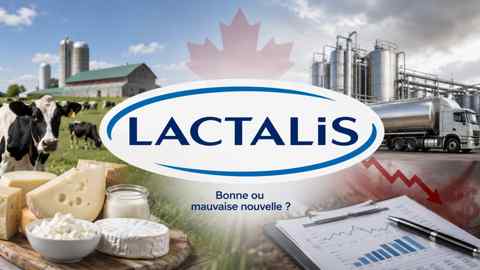
In less than a month, Lactalis has made two moves that deserve the attention of Canada’s dairy sector. On July 15, the French giant reached an agreement to acquire Agropur’s fine-cheese business, including the OKA, Monsieur Gustav and L’Extra brands and the plants in Oka and Saint-Hyacinthe. Then, on August 14, Lactalis announced a £988 million deal, about US$1.34 billion, to buy Saputo’s British dairy operations.
Two different transactions on two continents. But together they illustrate something much bigger: the rise of Lactalis in Canada is part of a global growth strategy, and Canada is clearly one of the markets where the group wants a larger presence.
So for Canadian dairy farmers, is that good news or bad news?
Lactalis in Canada: a giant that is actually investing
It would be too simplistic to describe Lactalis as a foreign company merely taking Canadian market share. The group already has a substantial industrial presence in this country.
According to Lactalis Canada, the company operates 19 manufacturing sites in Canada, employs about 4,500 people and processes roughly 2.2 billion litres of 100% Canadian milk. Since 2018, it also says it has invested more than $900 million in capital projects and transformation initiatives in Canada.
Its portfolio already includes extremely familiar brands: Cracker Barrel, Black Diamond, P’tit Québec, Balderson, Ficello, Astro, IÖGO, Olympic, Lactantia, Beatrice, Galbani and Président, among others. If the acquisition of Agropur’s fine-cheese business receives Competition Bureau approval, OKA, Monsieur Gustav and L’Extra will be added to that list.
From a dairy farmer’s perspective, there is an obvious positive argument here. A company that invests in Canadian plants and processes milk produced here is far more useful to our sector than growth based simply on importing finished dairy products.
But how large do we want Lactalis to become?
The downside is concentration.
Lactalis is not simply a large processor. The group describes itself as the world’s leading dairy company, with 2025 revenue of €31.2 billion, 266 dairies and cheese plants in 49 countries and 124 acquisitions completed over twenty years.
Acquisitions are therefore a core part of its strategy.
In Canada, that strategy has already reshaped the dairy aisle. When Parmalat, now Lactalis Canada, acquired Kraft Heinz’s natural-cheese business, the Competition Bureau noted that the main competitors in regular grocery-store cheese were essentially Parmalat and Kraft Heinz, Saputo with Armstrong, and retailers’ private labels.
The Bureau ultimately cleared that transaction in 2019, concluding that it was unlikely to substantially lessen competition. But each new acquisition gradually changes the landscape. The proposed purchase of OKA and Agropur’s other fine-cheese assets is itself expressly subject to Competition Bureau approval.
The real question is not whether Lactalis is “too big” simply because it is foreign. The question is at what point the concentration of brands, plants and processing capacity in one group’s hands begins to reduce meaningful competition. That issue of market power in the dairy chain also connects directly to the debate over farm-gate prices, processing and the supposedly free dairy market.
The Agropur case is especially sensitive
When market share moves from Saputo to Lactalis, it is essentially a transfer between two private companies processing Canadian milk.
Agropur is different. Agropur is owned by its dairy-farmer members. A business held by the cooperative therefore allows farmers, at least in principle, to participate more directly in the value created beyond the farm gate.
Seeing a producer-owned cooperative sell iconic brands such as OKA to a multinational can therefore create perfectly legitimate discomfort.
But Agropur’s own strategy also matters. The cooperative says its fine-cheese operations were profitable, but represented only about 2% of consolidated revenue and 2% of the milk processed in its Canadian plants. Agropur says it wants to focus investment on value-added fluid milk, industrial cheese, butter and dairy ingredients.
A few months before announcing the fine-cheese sale, Agropur unveiled investment projects approaching $1 billion in Beauceville, Quebec, and Bedford, Nova Scotia, to expand its capacity in value-added dairy proteins. Those projects still require final approval, but they suggest the cooperative is not abandoning the Canadian market. It is choosing where to concentrate its capital.
What about Saputo’s sale in the United Kingdom?
The agreement announced August 14 for Saputo’s British dairy operations is striking in size: £988 million. More than anything, it demonstrates Lactalis’s financial strength and appetite for acquisitions on a global scale.
It would be risky, however, to conclude that Saputo is selling in the United Kingdom because it expects an imminent battle with Lactalis in Canada. There is currently no public evidence establishing that connection.
The broader hypothesis remains interesting: in an increasingly concentrated global industry, major processors are choosing their markets and product categories with greater discipline. Some assets are sold to free up capital while other sectors receive large investments.
What we can say with confidence is that Lactalis is currently on the buying side.
Supply management does not answer this question
This development also highlights a distinction that is sometimes overlooked in debates about supply management and the pressures facing Canada’s dairy market.
Supply management is primarily designed to govern milk production, farm-gate pricing and access to the Canadian market. It does not guarantee that the companies processing that milk are Canadian-owned, much less farmer-owned.
It is entirely possible to maintain strong Canadian milk production under supply management while seeing a growing share of brands and processing capacity owned by large international groups.
That is not automatically a bad thing. A global processor can bring capital, technology, market access and marketing capacity that smaller companies may not have. But ownership of processing also influences where profits end up and who holds bargaining power in the food chain.
So, good news or bad news?
Probably both.
For Canadian dairy farmers, Lactalis can be good news when it invests here, modernizes plants and grows sales using Canadian milk. The company has the financial resources to support its brands against powerful retailers, develop new products and compete with other global giants.
But Lactalis’s growth becomes a concern when it steadily reduces the number of major independent processors and concentrates ever more brands and production capacity in the same hands.
The problem may therefore not be Lactalis itself. It is the speed at which the global dairy sector is consolidating.
For Agropur and Saputo, the recent transactions may be perfectly rational portfolio decisions. For Lactalis, they clearly fit a growth strategy that has been unfolding for decades.
And for us as dairy farmers, the issue deserves close attention. We benefit from having strong processors capable of investing and selling our products. But we also benefit from having enough of them that no single company becomes indispensable.
Sources
- Reuters, Lactalis to buy Saputo’s British dairy operations
- Lactalis Canada, proposed acquisition of Agropur’s fine-cheese division
- Agropur, agreement to sell its fine-cheese operations
- Agropur, investment projects in Beauceville and Bedford
- Competition Bureau, review of Parmalat’s acquisition of Kraft Heinz’s natural-cheese business
- Lactalis Group, key figures
Leave a Reply