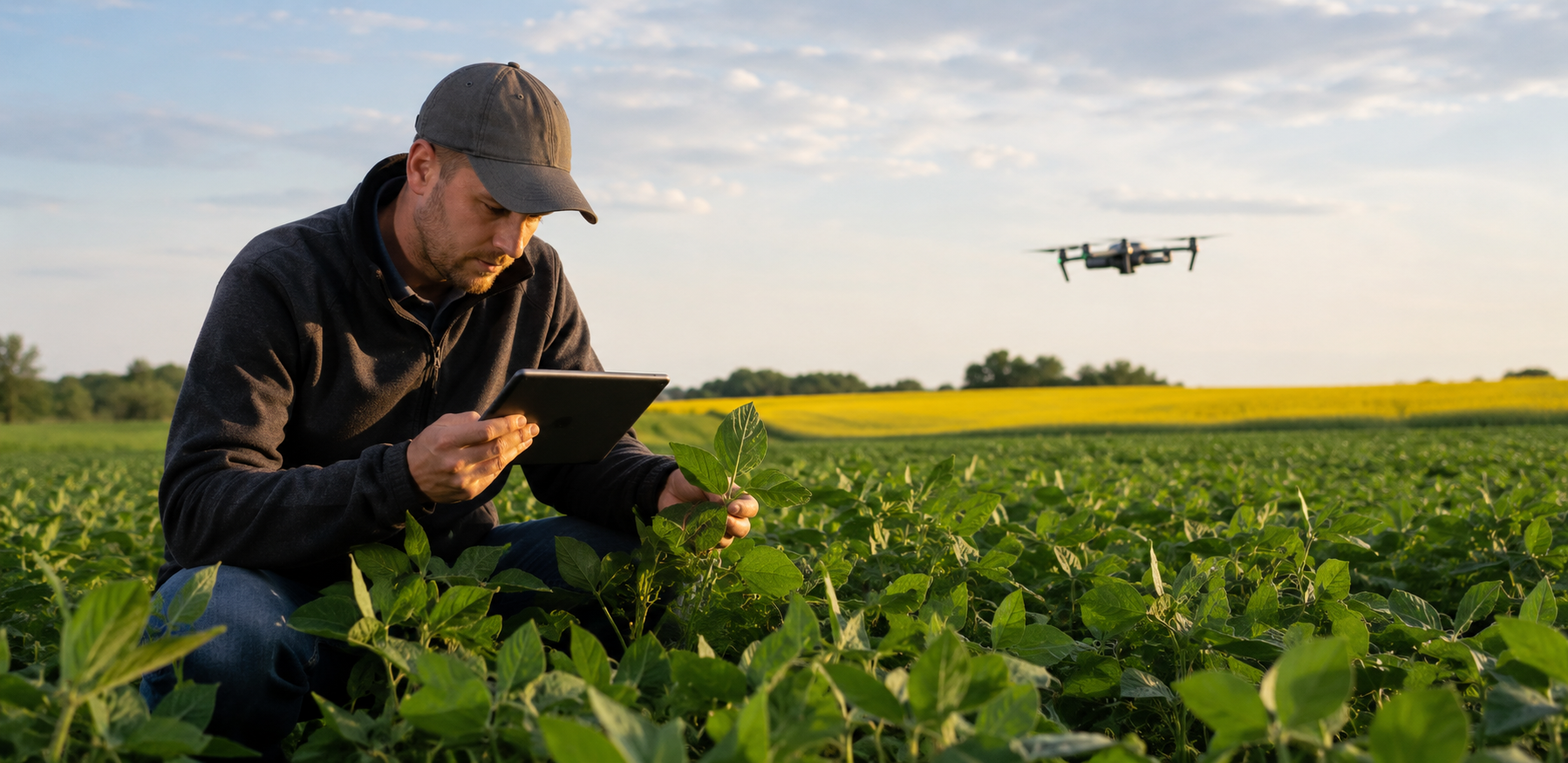
Today’s agricultural news is focused on improving the path from research to commercial use. Soybean researchers are refining the diagnosis of hidden nutrient problems, Ottawa is renewing a major agricultural technology fund, and Prairie canola growers will see a practical change in how Pioneer packages seed for the 2027 season.
Hidden nutrient problems may be limiting soybean yields
University of Guelph researchers are working to establish critical tissue-test levels for boron, iron, manganese and zinc in soybeans. Their longer-term goal is to develop an artificial intelligence tool that could identify micronutrient deficiencies before symptoms become visible.
Early work suggests both deficiencies and toxicities can reduce crop performance without obvious visual warning signs. Researcher Hugh Earl recommends confirming suspected problems with tissue testing and leaving an untreated check strip when applying a corrective product. Applying micronutrients preventively without a diagnosis can waste money and may create toxicity.
The team is also studying how drought affects biological nitrogen fixation. In controlled trials with low soil nitrogen, successful nodulation improved soybean yield under both adequate moisture and severe drought. More evidence is still needed before these findings can be turned into broad commercial recommendations.
Ottawa renews $50 million for agricultural technology
The federal government is providing another $50 million to the Canadian Agri-Food Automation and Intelligence Network. CAAIN will use the funding to support new innovation projects, expand its smart-farm network and continue its operations.
Created in 2019, the non-profit funds the development and adoption of technology intended to improve farm productivity, profitability or sustainability. CAAIN says it has invested $36 million in 51 projects, supported 885 jobs and helped generate more than 100 intellectual property assets. Those projects have attracted more than $500 million in follow-on private investment.
Thirty projects have completed their funding cycles and some have already reached the market. The real test for the renewed program will be whether it can move more Canadian technologies beyond trials and into tools that farmers can afford and use under commercial conditions.
My view: This investment matters. It will strengthen Canada’s capacity for innovation and help make our agricultural sector more competitive.
Pioneer will sell canola seed by seed count in 2027
Pioneer is changing all of its Canadian canola products from weight-based packaging to a minimum seed count for the 2027 growing season. Each bag will contain at least 4.25 million seeds, which the company estimates is enough for approximately 10 acres.
Bags will carry an A-to-E seed-size classification, while total bag weight will remain on the label so growers can adjust seeding rates for field conditions. The shift should make acreage planning and inventory easier because the amount purchased will correspond more directly to the target plant population.
The change also makes price comparisons more meaningful when seed size varies. A bag with a known number of seeds removes some of the uncertainty created when two bags of equal weight contain different seed counts, although establishment and final plant stand will still depend on germination, mortality and seeding conditions.
My view: This will be very practical when calibrating seeders. Knowing the exact number of seeds in each bag makes it possible to calculate precisely how much seed is needed for a given acreage.
Leave a Reply